Cooreman vs. Coareman: The Feud on the 1974 Ballot
In 1974, Steve Cooreman legally changed one letter of his last name so it would sit above his brother's on the ballot. Neither of them won.
BY KEN BRADFORD // POSTED NOVEMBER 15, 2026
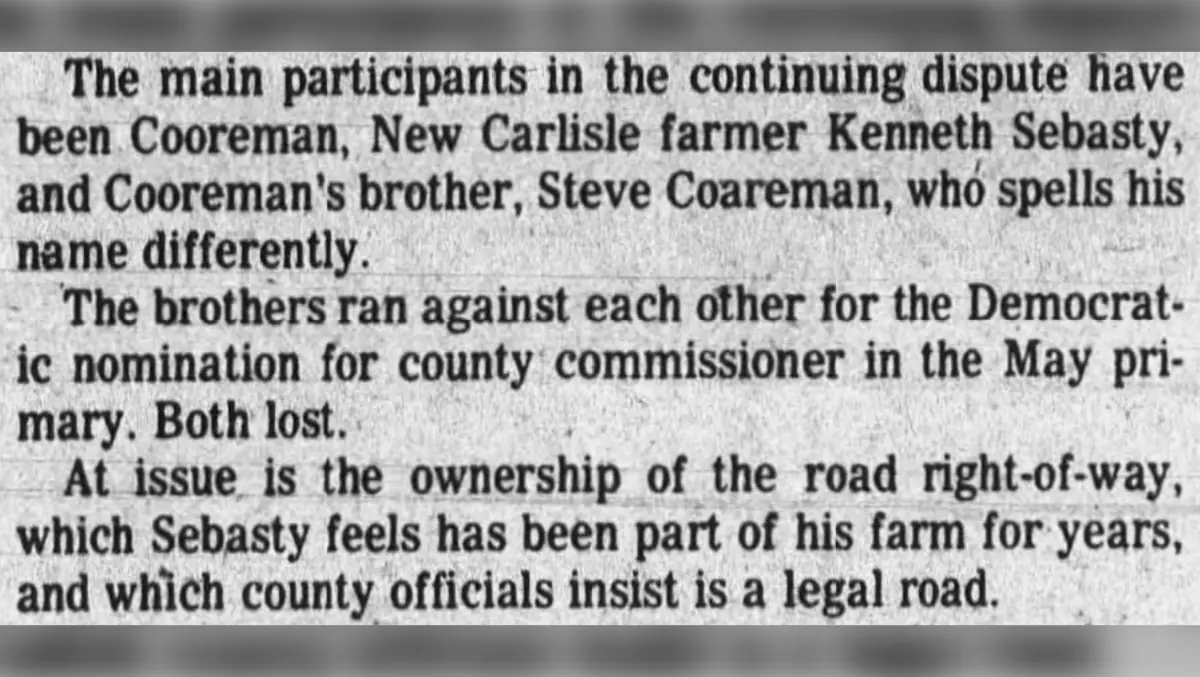
We're probably due for a break from tales of political shenanigans, but before you go, here's what happened when two brothers ran against each other for St. Joseph County Commissioner in 1974.
Augie and Steve Cooreman were prominent farmers who lived a mile apart off of Rosewood Road near New Carlisle. In 1966, Augie decided to run for commissioner, won the Democratic nomination and narrowly lost in the fall to Republican Keith Klopfenstein.
As 1970 approached, older brother Steve figured he would like to give it a try. But soon after he filed his papers for candidacy, Augie declared again, and he received the county party's endorsement.
In the May primary, Augie easily won the nomination with 9,507 votes. Steve was a distant fifth with just 1,584 votes. In the fall, Augie won his rematch with Klopfenstein by about 6,000 votes and became a commissioner.
In Steve's way of thinking, the wrong Cooreman got the job. He decided he would come back in four years with a new plan — and a new name.
A subscription to the News-Times is always free.
Enter your email address and get new issues straight to your inbox.
Before he filed his candidacy in 1974, Steve petitioned for a legal name change. As Steve Coareman, he knew that his name would appear alphabetically above his brother's on the primary ballot — C-O-A-R comes before C-O-O-R.
There was a brief brouhaha over it, but Steve had his papers from Circuit Court to prove his name now was Coareman.
“I didn't do this just to get ahead of my brother,” Steve told reporters at the time.
Honestly, he said, many of his supporters had voted for Augie by mistake in the 1970 primary. This name change would make it easier for voters to pick the right farmer.
Ouch, if it did. Steve's 1974 primary vote totals as a Coareman were just 786, half of what he got in 1970.
If there was a bright side for Steve, it was that brother Augie lost in the primary as well — by 114 votes to Richard Larrison. Maybe if Steve had stayed out of the race, or if he hadn't changed his name to Coareman — who knows if Augie would have had enough of those extra votes?
It's impossible to say, but when Larrison had his victory party in November's general election, Steve was right there at campaign headquarters, celebrating.
Steve, 18 months older than his brother, wasn't done just yet with the Coareman/Cooreman feud. In a letter published in the South Bend Tribune, Steve wanted everyone to know that this was all Augie's fault. Both brothers knew it was Steve's turn to run in 1970, and then Augie filed anyway, knowing his name would be first on the ballot. It wasn't fair.
It could have ended there, but it didn't.
Steve haunted the county commissioner meetings during Augie's waning days as a lame-duck commissioner. One of the big issues was Augie's approval of plans to improve a section of Huckleberry Road.
A potato farmer had Augie's support for putting a layer of gravel on that one-mile stretch. At public meetings, Steve vehemently opposed it. No one wanted stone on that road, he said.
It could have ended there, too, but two years later, in his next political move, Augie ran for county recorder and won. It's basically a paper-shuffling job, and rarely does the recorder face any controversy.
But somehow Augie ended up in a heated dispute with a local abstract company, whose owner happened to be a friend of Steve's, over access to property sale records.

When Augie ran for re-election in 1980, Steve had his revenge again. He and his abstract company pal backed Wanda Nowak in the Democratic primary. Nowak won, and Augie was done with politics.
Both of these successful farmers were decent men, active in their churches, social clubs and civic organizations. It's hard to say what drove them apart. Maybe it began with the last slice of a peach pie back sometime in the 1920s or maybe someone ended up in the back seat despite yelling “Shotgun” before a family vacation.
Whatever it was, it happened outside the public eye, and it's none of our business. And the feud, if it continued, was never mentioned again in the newspapers.
In any case, Steve ditched the Coareman name sometime in the 1980s, and when he died in 2003, his obituary listed Augie among his survivors. If it was of any consolation to Steve, he got to his deathbed first. Augie's death came in 2011 at age 95.
A subscription to the News-Times is always free.
Enter your email address and get new issues straight to your inbox.
As for the Cooreman/Coareman race, the Tribune's Jack Colwell reported in 1994 that there was another, quieter complaint about the ballot ABCs after the same 1974 primary, and it's likely that you haven't heard of that one either.
Republicans that spring were asked to elect delegates for their state convention. Twenty-two party members applied for the eight seats allocated to South Bend district No. 4.
Two of those applicants were mega-donors Judd and Mary Leighton, and a third was Jeannette Moeller, then the county party's vice chairman. Deserving as they were, all three of them lost while the person listed first on the ballot, a regular citizen named Helen Best, was one of the winners. How could that be?
It took a while, but the question ended up before the Indiana House of Representatives Election Committee in 1980. The committee, headed by Lakeville's Richard Mangus, cited a study that showed candidates listed first on a ballot had a 10 to 12 percent advantage over those who followed. Adams usually beats Zink.
That's why we have Indiana Code 3-10-1-18 on the books now. Henceforth, placement on the ballot will be determined by alphabetical order — with some exceptions. In counties with populations between 400,000 and 700,000, names will be ordered randomly, based on a lottery no more than 15 days after the deadline for declaring candidacies.
When first passed, this lottery rule applied only to St. Joseph and Allen counties. Nowadays, Lake County is the only one in that population category.
So, here's a thought.
It looks like the barndoor is open again, if we want to pull the same Coareman Switcheroo again here.
And, if you're able to change your name anyway, why stop with a single letter?
You might win in a landslide with a whole new name. A lot of voters would vote for Free Beer, if that was your name.