Remembering Mishawaka's Mayor Maggie Fifty Years Later
From 1963 to 1979, Margaret Prickett won election after election in a deeply Democratic city. Her secret was the river that divided her opponents.
BY KEN BRADFORD // POSTED OCTOBER 15, 2026
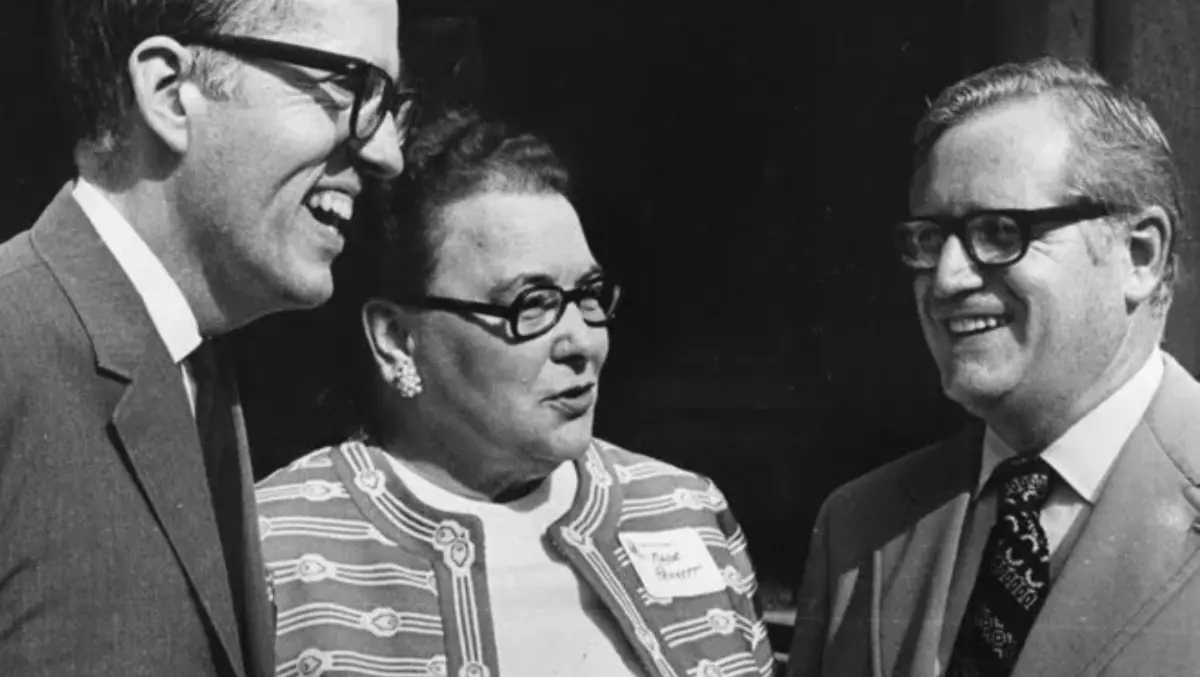
I finally had a good reason to meet Mayor Maggie.
Part of my job at the South Bend Tribune was to write about the Mishawaka Parks Department. I was working on a profile of the parks superintendent, Robert Dene, and that was the excuse I used to schedule 15 minutes with Mishawaka's legendary mayor.
This was in 1978, and Margaret Prickett had been mayor since 1963. In those days, it would have been difficult to find another woman mayor anywhere. I figured she must be something really special.
I left our interview after about five minutes. I had introduced myself as the new reporter in the Tribune's Mishawaka office, gave her a very brief rundown on my career thus far, told her about the article I was writing and asked her about some murmurs I had heard about Dene's brusque leadership style.
She replied slowly with just a handful of words to the effect of “He's doing a good job. He works hard at it.” We had a bit of an uncomfortable stare, and I thanked her for her time.
I left City Hall wondering what all the fuss about her was.
She was 70 years old, a fact I knew before the interview and, as a person, she left an impression of being some sort of a grandmother. Indeed, she was like my father's mother, who had sat at a table alone a few months earlier at a family wedding.
How on earth would someone like her get elected?
I have to admit that, having grown up in South Bend, I didn't understand Mishawaka at all. My answer now, nearly half a century later, isn't all that complicated.
A subscription to the News-Times is always free.
Enter your email address and get new issues straight to your inbox.
In Mayor Maggie's era, Mishawaka was still a deeply blue-collar city. Its residents worked mainly at three large factories — Ball-Band/Uniroyal, Wheelabrator-Frye, and Dodge Manufacturing — all of which hired by the hundreds.
These factories were central to Mishawaka's ethnic growth. Immigrants came to the city in waves, mainly from Italy and Belgium, and they established fairly tight residential districts that resisted outsiders.
The Belgians, for example, had a neighborhood on the south side of the river. Houses there were small but tidy. When I drove down 11th Street, I often would see Belgian grandmas in housecoats sweeping their sidewalks and driveways. And I was warned that I would never be able to buy a house in the Belgian neighborhood. If one were to be sold, neighbors would find a nice, young Belgian couple to buy it.
There were two Italian neighborhoods, also with well-cared-for properties, and their residents didn't get along with the Belgians or with each other. The feud between Italians living north of the St. Joseph River and those living south of the river was legendary, starting a century earlier, supposedly in villages in the Old Country.
One place that all these people found a home was in the Democratic Party, which included about 80 percent of all Mishawaka voters.
That estimate is based on the 1959 city primary totals, when 6,320 votes were cast for Democrats with just 1,672 for Republicans. In the fall, it was no surprise that Democrat Joseph Canfield easily won the mayoral office, and all five contested council seats went to Democrats as well.
Democrats, and Canfield, had every right to expect a long run in power. Entering the 1960s, the party was solid here and everywhere else. In 1961, John F. Kennedy became president. Indiana had a Democratic governor in Matthew Welsh and two Democratic senators, Vance Hartke and Birch Bayh. Our congressional district was in the safe hands of a prominent young Democrat, John D. Brademas, a Mishawaka native.
Canfield won his party's re-nomination in 1963. Republican leaders didn't have anyone else to challenge him, and they finally convinced Mrs. Prickett to run.
No woman had ever run for mayor in Mishawaka. She appeared to have no chance of winning – until the Democrats started pig wrestling with each other.
During the Democratic primary, Arthur Philion, Canfield's main opponent, had accused the mayor of misusing city services. Canfield was unfit for office. Philion declared he would rather vote for a Republican than support Canfield in the fall.
Mayor Maggie won by nearly 1,700 votes. She was joined at her victory party by hundreds of Democrats who, like Philion, had rebuked Canfield.
As it turned out, this wasn't a one-time tiff that would be resolved by Canfield's humiliation. In fact, Mishawaka had a North vs. South civil War for 1967, 1971 and 1975.
In the 1967 mayoral primary, south-sider Richard Brainerd won the Democrats' nomination in a five-man field, with north-sider Joseph Simeri finishing second. When Prickett won re-election in the fall, a major factor was the bad blood that stewed between Brainerd, Simeri and other contenders.
In the 1971 mayoral primary, Simeri lost again, this time to widely popular south-sider Hank Ferrettie. In the fall campaign, Ferrettie ran up record-breaking vote totals from his south-side base, but north-side Democrats again supported Prickett, who won a third term.
In 1975, Democrats changed tactics and nominated a north-sider, George Nome, over south-side favorite Ronald Smessaert in the primary. In the fall election, Prickett won again. This time her bonus votes came from the disgruntled Democrats on the south side.
I helped cover the 1979 fall elections, and I was assigned to the Republican headquarters when the returns came in.
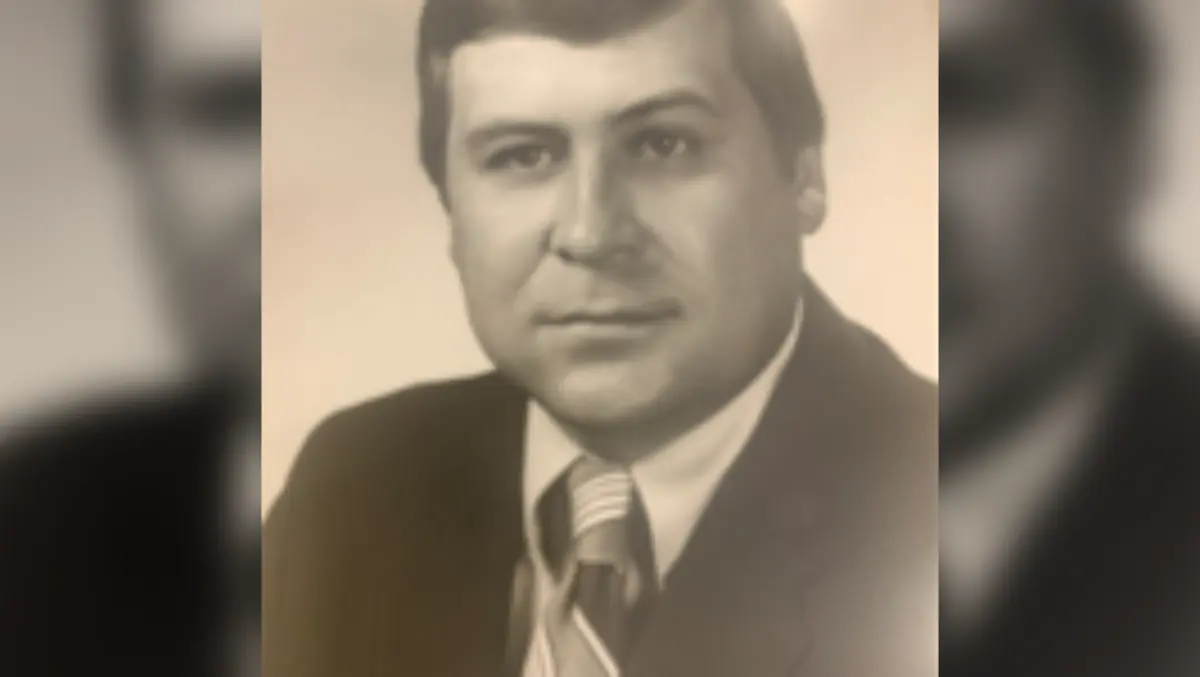
The Democrats had chosen Robert Kovach as their candidate. He had served a term on the Mishawaka city council and had been on the leadership track in the Indiana State Senate, where he served from 1974 to 1978. Just as importantly, he was neither a north-side Italian nor a south-side Italian.
Like Prickett, he had solid backing from his party. He ended up doing what none of the other four Democratic nominees could do since 1963. He won, defeating Prickett by 509 votes.
Try as they might, the Republicans couldn't get the Democrats to fight among themselves in 1979. The north-siders and south-siders had a truce, with just one candidate.
“When they do their thing,” observed city Republican Party chairman Don Sprague, “we just can't stop them.”
I talked with Mayor Maggie that night, and I pointed out in my story that she had accomplished much more than anyone had expected. She had been, with 16 years in office, the longest-serving female mayor in Indiana history.
“And Tuesday night,” I wrote, “Mrs. Prickett proved another idea wrong. Not all giants make a lot of noise when they fall.”
She quietly acknowledged that she knew this day would come eventually, and she seemed a bit relieved that her reign was over.
As it turns out, Kovach felt that way four years later. He had loved his time in state government, where big ideas were tossed around, argued about and turned into law. He didn't feel the same way about scrambling with a blue-collar crew appointed to appease various neighborhood factions.
He told me he never realized how many phone calls he would have to answer about burned out streetlights.
One night, I was enjoying a quiet beer at an out-of-the-way South Bend bar when I heard his distinctive loud laugh. When I turned to look, he saw me and pushed his way through the crowd, grabbing my arm.
“I come all the way here to get away from you guys so I can drink in peace,” he said. “Now I've got to find another place.”

Well before his term was up, he made it known he wouldn't be back. And sure enough, the Democrats had a bitter battle in the 1983 primaries. Kovach's choice for his heir, William Huys, defeated Joe Zappia, an old-school north-side Democrat, in the spring primary.
In the fall — no surprise, really — Huys saw a poor turnout in north-side precincts, allowing Republican Bob Beutter to win his first race for mayor.
Democrats haven't won since. Beutter served 20 years as mayor, followed by Jeff Rea for six and now by Dave Wood for the past 16. Republicans keep getting elected, so they must be doing something right.
Nearly everyone I've named in this article is dead and buried now. A lot of the things that bothered me about the city have faded away as well.
For example, if I wanted to, I could buy a house on 11th Street without explaining my family tree to neighborhood elders. The city, which was nearly 100 percent white in 1979, clocked in at 9.3 percent Black and 6.1 percent Brown in the 2020 census.
Mishawaka is not a paradise. With its three major manufacturers all gone, the median family income in Mishawaka is 33 percent below the statewide average. If you drive through the old Belgian and Italian neighborhoods with a critical eye, plenty of the sidewalks and driveways would benefit from an occasional sweep.
It makes me rethink my impressions about Mayor Maggie.
What we need from our leaders isn't always charisma. We don't need to be entertained or inspired. Sometimes, when the night seems a little too dark, we just want someone who listens when we complain about the streetlights.
That's true on both sides of the river.