The Forgotten Life and Strange Death of Tim MacCarry
He tore up his draft card, mobilized campus, and graduated from Notre Dame — then died in a suicide almost no one who knew him believed.
BY KEN BRADFORD // POSTED AUGUST 1, 2026
Here's a way to remember Tim MacCarry. It's probably from that night in 1969 when the Notre Dame anti-war activist tore up his draft card.
“Hundreds of us were heading up the road from the Grotto toward the main quad, and Tim was one of the organizers,” local author Tom Noe recalls. “He came back through the crowd and saw me in the lineup, so he asked me to lead the singing. He knew I had a strong voice. So, I started 'We Shall Overcome,' of course, and it caught on.”
But Noe's memories aren't perfect. It could just as easily been another night — after a march, a sit-in or a resistance meeting — in those turbulent times. If Tim was there and asked you to sing, you sang. If he suggested to march, you marched.
MacCarry was one of a half-dozen anti-establishment leaders who helped mobilize students on the Notre Dame campus. Young people here and everywhere were angry about the war in Vietnam, which was killing about 1,000 Americans each month. The U.S. government wasn't listening, and as far as MacCarry could tell, neither was the university.
A subscription to the News-Times is always free.
Enter your email address and get new issues straight to your inbox.
On October 15, 1969, MacCarry, three fellow students and two professors stood up and shredded their draft cards. It was a federal crime to do that, and they knew that the FBI would investigate. If convicted, they could face up to five years in prison and a $10,000 fine.
Tearing a draft card? MacCarry wasn't finished.
A senior from White Plains, New York, he spent much of that year planning rallies, writing a weekly column in the college newspaper, and leading discussions in the student center about America's misdeeds.
Weeks after tearing up his draft card, he and his anti-war group were seething that Notre Dame would allow the Central Intelligence Agency and Dow Chemical to recruit on campus. The reason for hostility toward the CIA was obvious. These were the guys responsible for starting and stoking the war.
But Dow Chemical's role seemed even more dastardly. The company was profiting off its sale of napalm, which American pilots dropped on enemy villages and forests. Napalm was gooey. It would stick to your skin while it continued to burn.
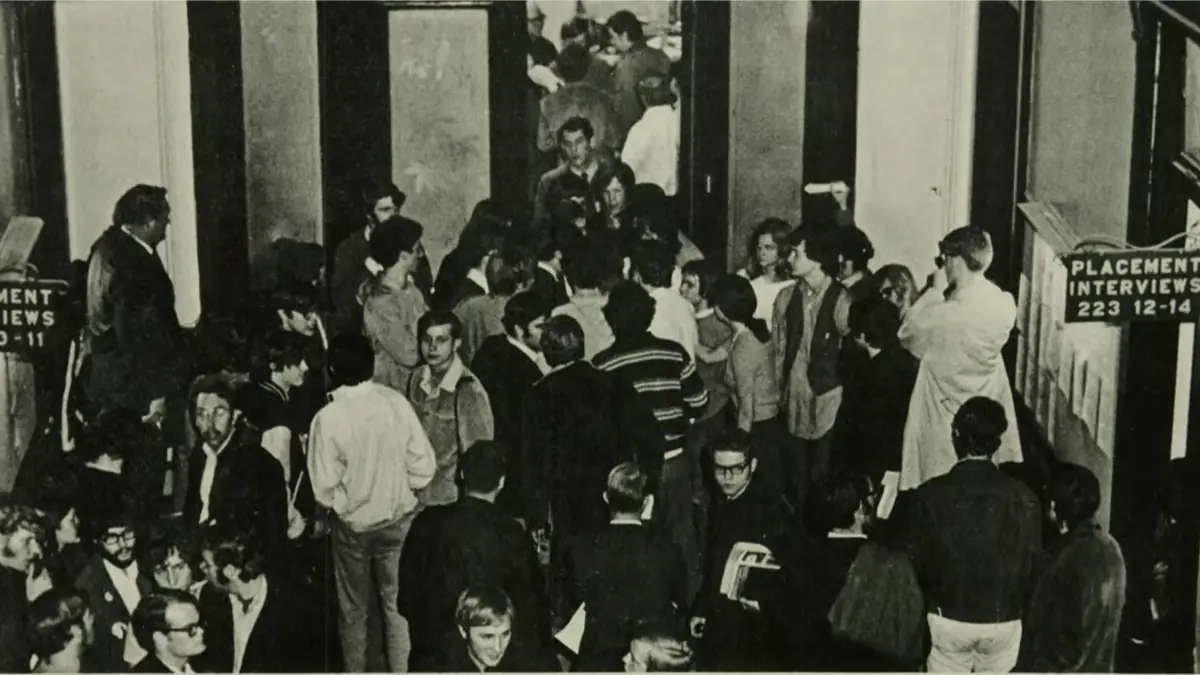
On November 17, 1969, as CIA and Dow recruiters were setting up in the Placement Office in the Administration Building, some 250 students and faculty members gathered outside to block access.
School leaders asked them to move. They didn't. They vowed to be back the next day to do the same.
The next step for the university was to file an injunction in the county courts. When the protesters appeared as promised on November 18, so did the county police. Officers weren't particularly gentle with MacCarry, who was among the five people arrested.
The case hit a snag when the protesters filed a petition demanding that the university disclose any business relationship between itself, the CIA and Dow. A judge ruled in favor of Notre Dame, but the point was made, and charges against the students disappeared.
MacCarry continued, undeterred. Nixon's war effort expanded in the months ahead. Notre Dame protesters scheduled Complicity Week, where they promised to show how the university's actions were aiding the Vietnam War effort.
The organizers had a specific demonstration in mind. They were going to set fire to the corpse of a lamb doused with napalm. After howls from the student body, the immolation was cancelled.

The campus mood crescendoed during the first week of May 1970. Nixon's America expanded the war into Cambodia, and protests expanded on campuses nationwide. At Kent State, National Guard troops were called in by the governor and shot four students to death.
Raw anger spread at Notre Dame, even among students previously ambivalent to the war. A strike was scheduled by the student body president, MacCarry's crew, and others to shut down classes before final exams.
The university's president, Father Theodore Hesburgh, had been moved as well. His speech to an on-campus rally gave students a clear message: He was on their side.
This was a major change for Hesburgh. A year earlier, he gained national attention with a directive, known as the 15-minute rule, that curtailed acts of protest on campus. The simplified version is that protesters would have 15 minutes to state their case. After that, it was time to leave. If you didn't, the university would collect your ID card and expel you.
The rule was invoked only once. On the day MacCarry and four others were arrested at the CIA/Dow protest, 10 students refused to disperse. They were all suspended for a semester as a result.
Hesburgh had been a leader in the civil rights movement, famously walking arm in arm with Martin Luther King Jr. at a rally in Chicago in 1964. His 15-minute rule showed that his judgment wasn't perfect.
His arbitrary limit on protest gave all power to those favoring the status quo. For example, can you imagine the effect on civil rights protests if Dr. King had been given a 15-minute ultimatum during his “I Have a Dream” march on Washington?
A subscription to the News-Times is always free.
Enter your email address and get new issues straight to your inbox.
The May 1970 campus shutdown ended, mainly because the calendar flipped. It was time for the seniors, including MacCarry, to graduate and go home.
He graduated summa cum laude — with highest honors — in May. As the legend goes, he received his diploma but couldn't participate in the ceremonies. As his final act of rebellion at Notre Dame, he showed up at commencement with a coffin calling attention to America's war dead. Campus security officers took him into custody and wouldn't let him out until the ceremony was over.
At this point, you might be wondering why you've never heard of Tim MacCarry before. It's not just you. I arrived on campus in the fall of 1972. I don't believe I'd ever heard his name. I reached out to some of his classmates, and they had only vague recollections of Tim.
For many at Notre Dame, the1969-70 school year was a time for focusing on their social lives, their grade-point averages and the football team — #5 in the nation with a narrow loss to #1 Texas in the Cotton Bowl.
You can read all about it in the student newspaper. The Observer's archives are available online. It's plausible that there was so much turmoil then — protests against the board of trustees, a potential ousting of Hesburgh, looting after an on-campus panty raid — that the whole year disappeared into a fog.
Tom Noe, an author and editor from Kansas City who has stayed in South Bend after graduation in 1969, is one who remembers and respects the way Tim was committed 100 percent to his beliefs.
“In my memory, Tim was completely nonviolent, the Martin Luther King kind of approach,” he recalls. “He certainly favored that approach, both for philosophical and theological reasons.
“I respected him a lot,” continues Noe. “He had a kind of waiflike charm and was soft-spoken, very much present in every conversation. Intense.”
And it wasn't just anti-war rhetoric. Tim had reached into the underprivileged community. He set up an informal children's center to help introduce youngsters to the Scriptures. He briefly operated the St. Francis Catholic Worker house east of campus.
He organized a boycott of dining hall desserts, asking that all savings be donated to those who were hungry in the university's neighborhood.
It's a stretch for the rest of us to understand, then, what happened next. This dedication to social justice, rooted in religious principles, seemed to careen entirely toward Communist ideology.
Among his next moves was a visit to Cuba, where he and other radicals worked on a collective farm and immersed themselves in revolutionary strategies. His younger brother, Noel, told a magazine writer that the optimistic part of Tim seemed to disappear after that.
After Tim enrolled in a doctorate program at University of California-Irvine, he continued his social activism there. And that's where he died.
Police found his body on March 18, 1971, on a street in Santa Ana, California, with a .22 caliber rifle at his side. A receipt in his pocket indicated he had purchased the gun earlier that day.
The investigation was quick. Suicide.
Something didn't seem right about it, and his acquaintances were shaking their heads. Close friend Charlotte Casey told the Observer, without elaborating, that “for political reasons, further investigation would not be productive.”
Father Hesburgh, in one of his autobiographies, stated that he didn't believe the verdict of suicide. But he added that people like Tim don't find the same sort of support and nurturing once they leave a college campus.
If you've dabbled in conspiracy theories, like the Kennedy assassination, the receipt for the rifle isn't convincing. It just adds to the suspicion — a skilled assassin tidying up.
One more thing: Tim was an accomplished writer. His suicide note would have been epic, but he didn't leave one. A lot of this is addressed in a 2025 article in The Revealer online magazine by David Griffith.
A subscription to the News-Times is always free.
Enter your email address and get new issues straight to your inbox.
White Plains is a suburban city about the size of Mishawaka, Indiana, less than an hour northwest of midtown New York City. Tim had been a valedictorian of his graduating class at Spring Valley High School, where he also starred in music and sports programs. This community had sent one of its best bright-eyed boys to Notre Dame.
As a high school junior, he won a national Westinghouse Science Talent Award for his study of rock formations and had spent several weeks in a Science Foundation Program at Syracuse University. He was brilliant, a boy with big talents and big dreams.
After his death, 55 years ago, it was up to his family to explain his fate to the community that had adored him, and they did so in a news story by recalling the message of his valedictory speech: “Even then in his very young life he was concerned why so many of us in the establishment settle, in his own words, 'for full stomachs and empty minds.'
“He never hesitated to say what he thought, we know he will live on because of that. We have always said that we tried to teach him to think for himself and we never second-guessed his decisions. We cannot do so now and we appeal to his friends and to ours to pray for the causes he felt were right.”
Causes? All these years later, with all that we've learned, a significant minority of Americans still believe we did the right thing while losing some 58,000 young lives — and a war — in Vietnam. And they'll back the Red, White and Blue whenever we pick similar fights elsewhere with similar consequences.
World hunger. International pandemics. Global warming. Ethnic cleansings.
Someone else's problems.
It seems clear that America still runs on a full stomach and empty minds. What became of those prayers that day for the causes Tim felt were right? Did anything about Tim live on?
It makes you wonder: What kind of world would it be if Tim MacCarry were here, asking us to sing as we choose, and we sang?