The Time the Confederacy Invaded Indiana
For a few days in July 1863, General John Morgan brought the Civil War to the Hoosier State.
BY AARON HELMAN // POSTED APRIL 13, 2026
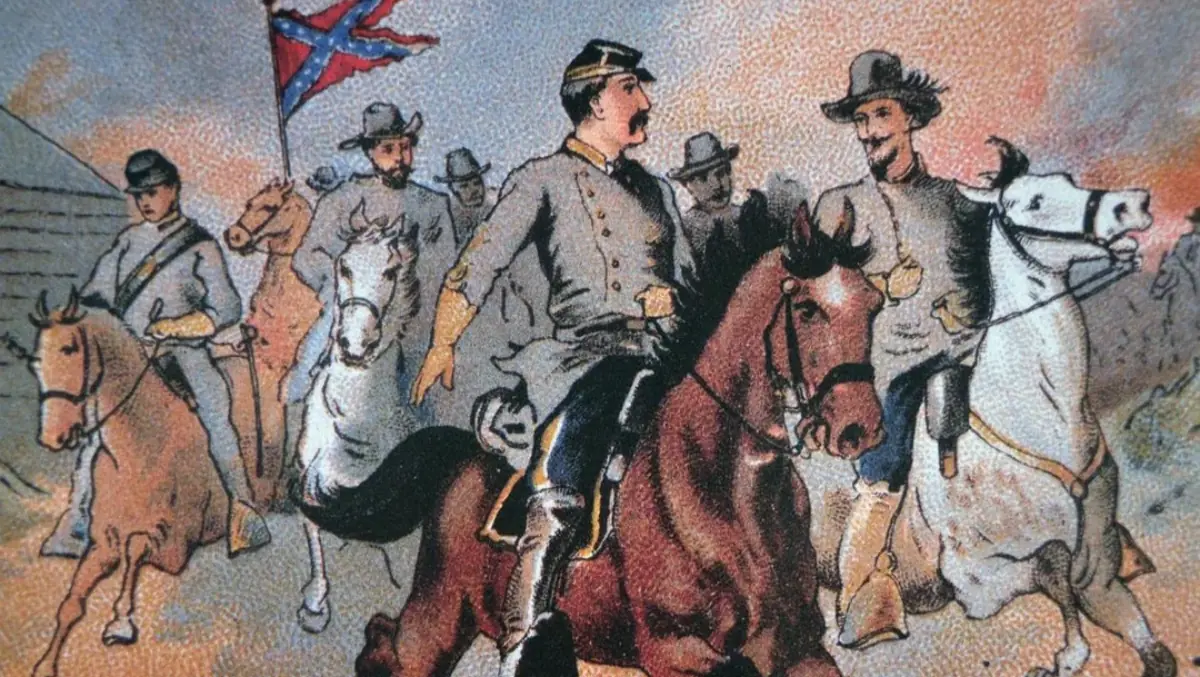
In the summer of 1863, the Civil War was being fought in places with names that Hoosiers knew from the newspapers — Gettysburg, Vicksburg, Chattanooga. It was a war that happened somewhere else, to someone else, and Indiana's role was to send its men south and wait for news.
John Hunt Morgan decided he had other ideas.
Morgan was a Confederate cavalry general out of Kentucky, and he was exactly the kind of man who had other ideas. He was bold to the point of recklessness, charismatic to the point of dangerous, and he had spent the early years of the war making Union commanders look foolish with a series of raids through Kentucky and Tennessee. By the summer of 1863, he had earned a reputation and he knew it.
His superiors knew it too, which is why General Braxton Bragg gave Morgan his orders with unusual specificity: ride into Kentucky, create a diversion, and under absolutely no circumstances cross the Ohio River into Indiana.
Morgan crossed the Ohio River into Indiana.
A subscription to the News-Times is always free.
Enter your email address and get new issues straight to your inbox.
Morgan's Raid was not without its logic, although it certainly came without a directive. Bragg needed Union cavalry pulled northward and away from his own troop movements in Tennessee. Morgan's job was to create a diversion, but Morgan wanted more than that.
He wanted to bring the terror of the war north. He wanted Hoosiers to feel what Tennesseans felt — to wake up one morning and find nearly 2,500 Confederate cavalrymen on the other side of their front door.
Morgan also knew that Indiana wasn't entirely hostile territory — at least not in theory. The Copperheads were a faction of Northern Democrats who openly opposed the war, and in Indiana they were well-organized and vocal enough that the governor considered them a genuine threat to the war effort. Morgan was counting on them. His hope was that his arrival would embolden Indiana's Copperheads to rise up, rally to the Confederate cause, and turn the state into a liability for the Union from the inside.
On July 8, Morgan's men seized two steamboats on the Ohio River and ferried across into Indiana near the town of Mauckport. They looted Mauckport before they'd even gotten their boots fully dry.
Indiana's governor, Oliver Morton, immediately called for volunteers to take up arms. Thousands responded. But thousands of hastily organized volunteers are not the same thing as an army, and Morgan knew that too.
At Corydon, Morgan's forces ran into a militia line of several hundred men who had thrown up a barricade of logs and were prepared to make a stand. The stand lasted less than an hour. Morgan's men outflanked them on both sides, scattered them, and moved on. There were dead on both sides, and the civilian toll keeper at the road outside of town was killed near his gate.
Morgan made his headquarters that night at Corydon's main hotel. His men helped themselves to the county treasury, raided the stores, demanded meals from the town's women, and took several hundred horses from the farms nearby, leaving their own exhausted animals behind.
It would be the pattern for the next three days.
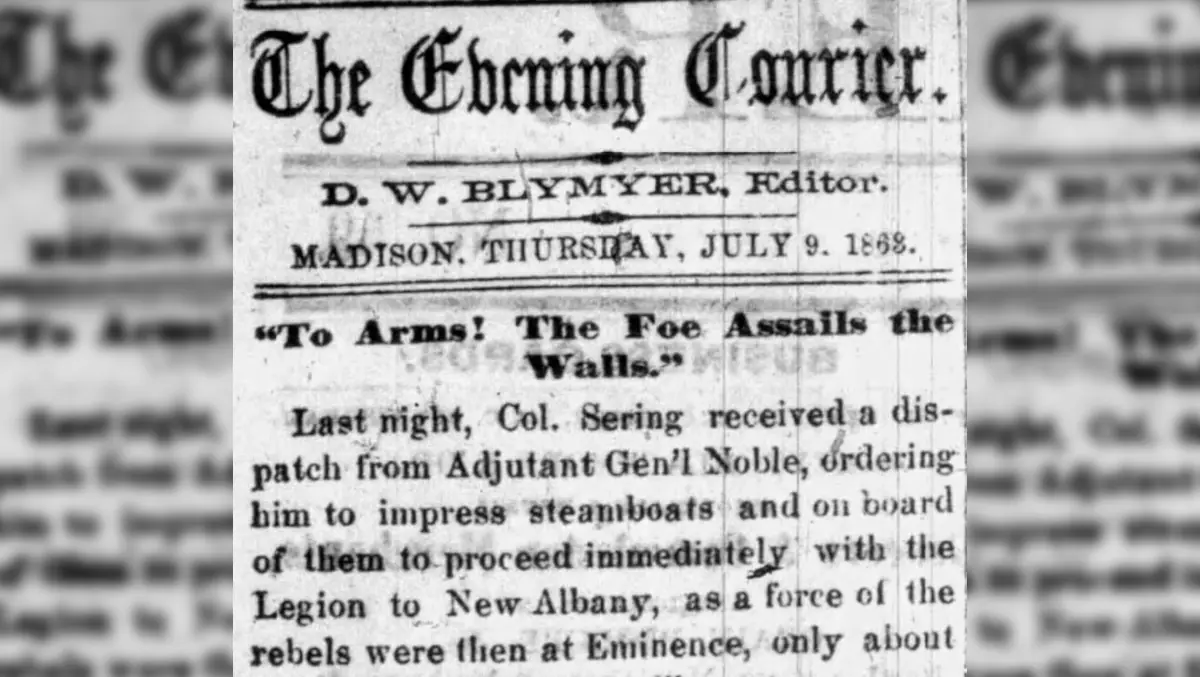
The raid moved fast because it had to. Salem fell on July 10. The depot was burned, the telegraph wires were cut, and Morgan's men demanded ransoms from local merchants in exchange for not burning their stores. They weren't always paid, and the stores weren't always spared.
One of Morgan's own officers later wrote that by Salem, his men had lost all proportion. They seized bolts of cloth, birdcages, and ice skates — things that were of absolutely no use to a cavalry unit on a hard ride through enemy territory. The officer said they pillaged like boys robbing an orchard. He was not being complimentary.
Morgan burned bridges and tore up rail lines as he moved northeast through Indiana, but he was never going to be able to do the kind of damage that could actually slow Union operations. He had no reinforcements coming. He had no resupply line. He had 2,460 men in the middle of a state that hated him, with Union forces mobilizing in every direction.
The Copperhead uprising he was hoping to spark never came. No Indiana recruits came flocking to the Confederate cause. The terror he'd intended to sow curdled quickly into something that looked more like outrage, and the outrage made Hoosiers want to fight, not surrender.
By July 13, Morgan was out of Indiana and into Ohio, with Union forces closing in fast. He was captured in eastern Ohio before the month was out.

The raid accomplished almost nothing it set out to do. No city was occupied. No railroad stayed closed for more than a few hours. No uprising materialized. Two brigades of good Confederate cavalry were captured or scattered, and Union operations continued more or less as planned.
What it did do was give Indiana something it had never expected to have: a story, a legacy, and a more personal taste for revenge. For a generation of Hoosiers who sat on their porches that summer and heard hoofbeats coming down the road, it was the most frightening thing that ever happened to them. They talked about it for the rest of their lives.
John Hunt Morgan was killed in a Union raid in Tennessee in September 1864, fourteen months after he crossed the Ohio River without permission and made Indiana a footnote in the history of the Civil War. He is buried in the Lexington Cemetery next to a statue that is supposed to be his horse. Every year, students from the University of Kentucky alight upon the cemetery to paint the horse's testicles blue and white.