Pierre Navarre: First, But Not a Founder
He came to South Bend before South Bend existed. He just wasn't particularly interested in what came next.
BY AARON HELMAN // POSTED MAY 17, 2026

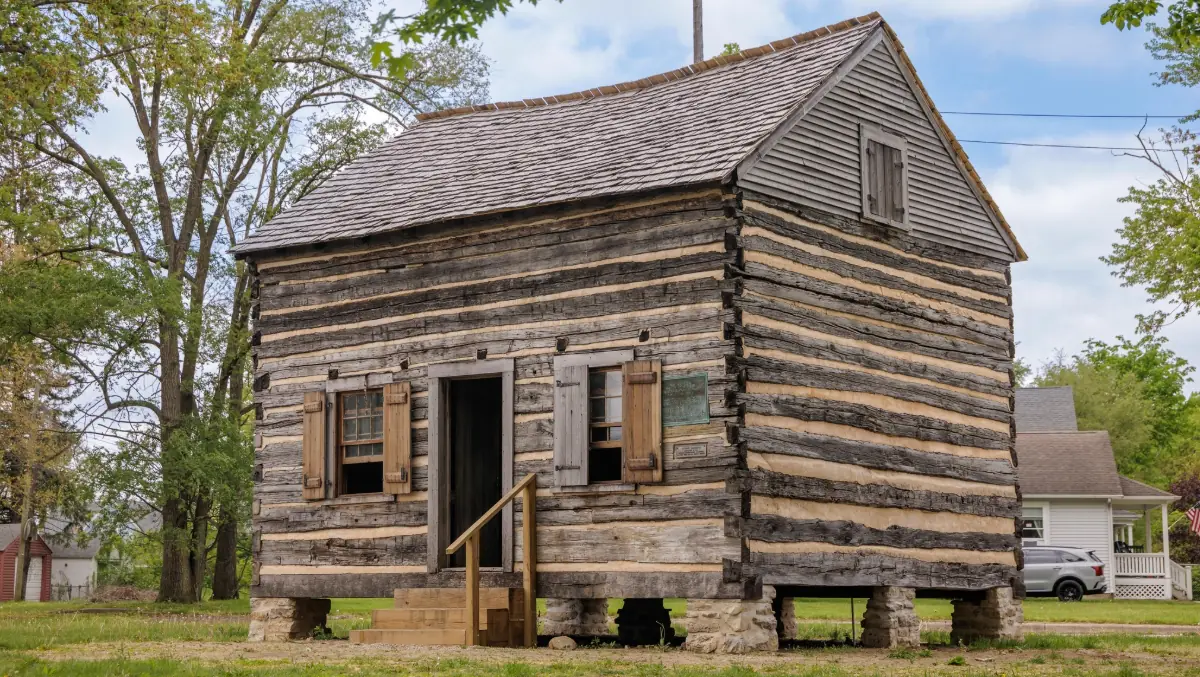
In 1820, Pierre Navarre arrived at a bend in the St. Joseph River and built a cabin. There was no town. There was no plan for one. There were no streets, no lots, no commissioners, and no grand ambitions about what this place might one day become. There was a river, a forest, a trail that Native Americans had traveled for generations, and now there was one white fur trader from Monroe, Michigan.
That fur trader was Pierre Navarre, and he was the first European-descended settler at the place that would become South Bend, Indiana.
During the coming decades, more settlers would arrive. A town would be platted. Streets would be named. The Native Americans would be driven away. All of it would happen without much involvement or input from Pierre Navarre.
Today, the men who get credit for founding South Bend are Alexis Coquillard and Lathrop Taylor, who arrived in 1823 and 1827 respectively, and who became the chief builders of the town and city of South Bend. Navarre — who was here first, who built the first permanent structure in the county — gets remembered as something of a curiosity.
I'm not so sure Pierre Navarre himself would disagree with that assessment.
A subscription to the News-Times is always free.
Enter your email address and get new issues straight to your inbox.
Shortly after his arrival, Navarre married a Potawatomi woman named Kechoueckquay. The historical record gives us very little of her. We know she was born around 1805. We know she received a grant of land under the Treaty of 1828. We know she took the Christian name Angelique at some point. We know she married Pierre Navarre shortly after he arrived in the place that would become South Bend.
Beyond that, the record goes quiet in the way that records so often do when it comes to Native American women of that era. Even her name appears differently in nearly every source that mentions her — Kechoueckquay, Keshawaquay, Kish-wa-quah, a half-dozen other attempts by European ears to catch a sound they weren't quite built to hear.
Her origin is similarly uncertain. One story says her father was a Potawatomi chief named Wabaunsee. Another says her father was English — that he tried to take her back to England with him after her Potawatomi mother died, and that the tribe took her back, because in Potawatomi culture, inheritance ran through the mother. There may be truth in both stories, or neither. We're not sure.
What we do know is this: when Pierre Navarre married her, he didn't bring her into his world. He went into hers.
While Coquillard and Taylor were buying land and drawing roads onto virgin maps, Navarre was living a different kind of life. He didn't rub shoulders with the men trying to will a city into existence. He stayed with his wife and their children. The Potawatomi were his people now, or maybe he was theirs.
In the late 1830s, when the Indian Removal Acts reached into Indiana and the Potawatomi were forced west along what would become known as the Trail of Death, Navarre went with them. He packed up and walked west alongside his wife, her tribe, and their children. He is alleged to have said, somewhere along that march, that he had no other choice — that by then, he was as much an Indian as any of the others.

Kechoueckquay died in Kansas, probably in the early 1840s, a year or two after arriving. The historical record doesn't tell us the precise date or the cause. It doesn't tell us much about what her death meant to the man who had reorganized his life around her. What it tells us is that after she was gone, Pierre Navarre came back.
He returned to South Bend in 1850. By then the town had a population of more than 1,500. The streets were named. The businesses were running. The founding had been done, thoroughly, by other people. Navarre was 63 years old, a widower, and he had no more interest in town-building than he'd ever had.
He lived quietly with one of his daughters and died on December 27, 1864 — as South Bend was already a thriving, modern town, and just months before it was officially incorporated as a city. He is buried at the Cedar Grove Cemetery.