Why Is It Called Portage Avenue?
For thousands of years, South Bend's Portage Avenue sat at the center of the New World.
BY AARON HELMAN // POSTED JULY 5, 2026
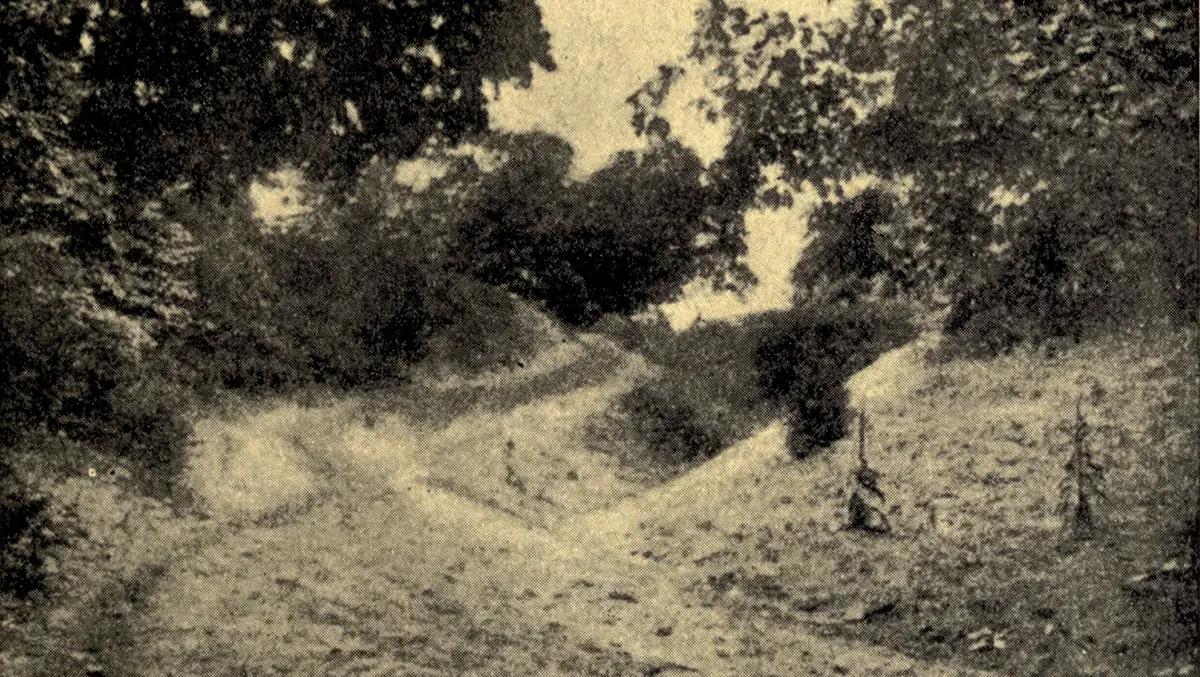
It's twelve thousand years ago in South Bend and the glaciers are leaving, but they're not leaving quietly.
As the air warms after uncounted frozen centuries, the mile thick ice sheet crawls slowly toward Canada carving and scraping the bedrock, pushing through the earth like an Oliver plow. The meltwater pools in the low places and those low places become Great Lakes. In between those lakes, the glaciers impress the crooked beginnings of the rivers that will spend the next several thousand years carving courses of their own.
The glacier doesn't do any of it on purpose, but it has left behind an obvious place for a town. It has left behind one of the most important intersections on the continent. It has left behind a narrow ribbon of dry ground between two rivers — a path that no one will bother to name for another twelve thousand years.
They'll call it Portage Avenue.
A subscription to the News-Times is always free.
Enter your email address and get new issues straight to your inbox.
The glaciers didn't just leave rivers and lakes. They left watersheds, the large and wide stretches of land where all of the water flows in one direction, at least until you cross some invisible line and all of the water flows in a different direction. South Bend sits in the middle of two of those watersheds.
The St. Joseph River will run north to Lake Michigan and, from there, east toward the Atlantic. The Kankakee River will run southwest to the Illinois, the Illinois to the Mississippi, the Mississippi to the Gulf of Mexico. Two rivers, pointed at two different oceans — and at the sharp southern bend of the St. Joseph, they come within a few miles of touching.
At some point, someone walked the gap between the two rivers. People have been walking the gap ever since. Here's why it matters:
In the years before cars and railroads and Studebaker wagons, the water was the only highway there was. If you wanted to move anything — furs, food, tools, weapons, people — you put it in a boat and let the river do the work. It was faster than walking, gentler on the body, and a canoe could carry far more than a man's back ever could.
The only trouble with rivers is that they don't all connect. And when you needed to cross from one river system into another — out of the Great Lakes watershed and into the Mississippi watershed, for example — you had to climb out, hoist the boat and every last thing in it onto your shoulders, and carry it overland to the next river.
The shorter that carry, the better. And the shortest carry between those two enormous water systems was just four miles beginning at the southernmost bend of the St. Joseph River.
The trail between the two rivers was pounded so smooth and worn so deep by generations of moccasined feet and dragged canoe hulls that it sank into the ground like a groove. Every major Native trail in the region converged on this spot like the arms of a great, wide asterisk. It was a trade route, a highway, a seam stitching the people of the Great Lakes to the people of the Mississippi. The Miami, whose own origin story begins on the St. Joseph, tell of ancestors who emerged from the water and pulled themselves up the riverbank into being.
For centuries, it was one of the busiest intersections in North America.

Everything that happened next happened because the portage was already here. Robert de La Salle came here looking for the portage that his Native American guides had been telling him about since the moment he arrived in the region. When the first fur traders showed up more than a century later, they didn't choose their spot at random. They set up a trading post at one of the busiest intersections on the continent, a choice not any more prescient than putting a gas station at a busy offramp.
A town grew up around those trading posts. They called it South Bend. They made it official in 1831.
And then, after existing as a continental artery for a dozen centuries, the portage fell out of use. Wagon trails and railroads took the men who used to travel on the water. The old portage trail became filled with leaves and grass. It was sometime after that before they paved it and gave it a name:
Portage Avenue.