What's Next for Tippecanoe Place?
For 130 years, South Bend's most storied mansion has defied every threat — but its latest chapter is still unwritten.
BY AARON HELMAN // POSTED APRIL 6, 2026
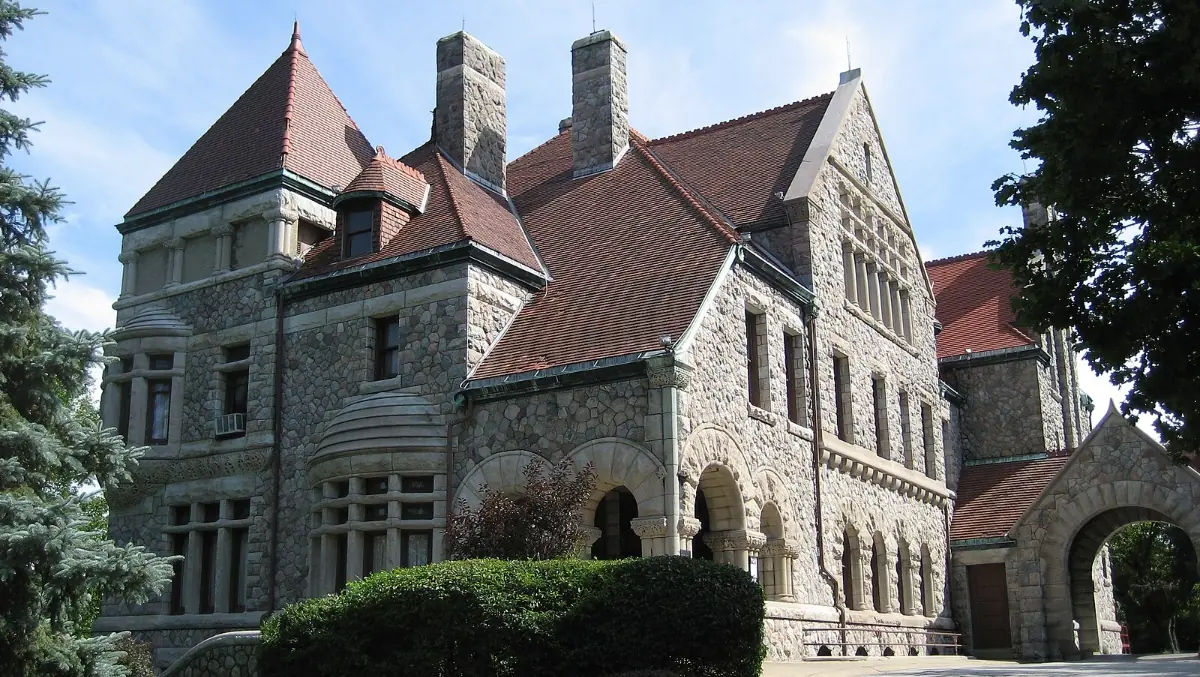
The first thing that happened after they finished building Tippecanoe Place is that it caught on fire, and it was not a small fire. It was barely six months after Clem Studebaker and his family had moved into the stately mansion on Washington Street that the blaze tried to take it down on October 9, 1889. The newspapers estimated the damage at $300,000.
It had taken four years to build and furnish the mansion. It took less than three hours to burn it from the inside out. The furniture and the furnishings were a complete loss. The windows were exploded from the screaming heat of the hungry flames.
But the beautiful stone that gave the home its walls and its shape and its character? They survived the fire and they've remained in their place ever since — for more than 130 years.
The fire couldn't have happened at a worse time. Clem Studebaker had been working with Secretary of State James Blaine to bring a collection of dignitaries from South and Central America for a tour of the United States. Tippecanoe Place was on the agenda.
The problem was significant and pressing. The dignitaries were already in the States, and in fact, Clem had been with them in New York on the day his home burned. They were slated to arrive in South Bend ten days later.
The people of South Bend knew the event was a big deal, but they couldn't have known how big. Besides featuring a handful of Washington's top-ranking officials and America's biggest titans of industry, the international delegation contained at least five South American Presidents, one Prime Minister, and three Secretaries of State.
The group arrived in South Bend to tour its various factories — Oliver, South Bend Toy Company, and, of course, the world-famous Studebaker operation.
The group had been scheduled for a lunch at Tippecanoe Place, and Clem Studebaker was not about to miss the opportunity to show off his home. He kept the appointment, and the most consequential international delegation South Bend has ever seen ate lunch in the charred remains of his Washington Street home.
A subscription to the News-Times is always free.
Enter your email address and get new issues straight to your inbox.
Today's Tippecanoe Place stands as one of the last remaining structures of the vast Studebaker legacy, and that's exactly what Clem was hoping for when he announced his intention to build the home in 1885, saying he needed a more stately home, “one more nearly corresponding in its character with the position I have obtained in the affairs of the world.”
At more than 24,000 square feet, with 40 rooms and a staggering 20 fireplaces, Studebaker must have esteemed his position quite highly indeed.
By 1890, the house had been restored to its pre-fire glory, and Clem would enjoy the home for the next decade. Clem died in 1901 and his wife followed him in 1916. The mansion passed to their son, George, with the expectation that it would remain in the family forever.
The depression was not good to George Studebaker, and in 1933 he was forced to give up the keys to the home as part of a bankruptcy deal.
Then came everything that happened next.
George Studebaker was the last person to keep Tippecanoe Place as a home. 1933 was not a good year for anyone, and the market for stately mansions was pretty well dried up. The home sat empty for a number of years and it aged the way that old, empty homes tend to do.

It was 1941 before anyone thought to do anything with the big house and all of its rooms. That's when Ernest M. Morris stepped in to purchase the home. He donated it to the city to be used as a home for disabled children.
It was just one of the ways that the Morris family would save the city from destruction. Morris gets the lion's share of the credit for saving South Bend's banks during the Depression.
Later, when the city tried to tear down its historic theater, Ernest's wife stepped in to save it. In return, they named the place after her — The Morris Performing Arts Center.
Of course, the mansion was going to need some work before it could become a school for disabled children. The home wasn't exactly the most handicap-accessible place in town.
Workmen had hardly begun the work of the building's transformation when the nation was visited by a more urgent cause — the American entry into World War II.
Tippecanoe Place was transformed in a matter of weeks, becoming a regional headquarters for the Red Cross. It was only after the War ended that the old Studebaker mansion could become the school the Morrises had originally imagined.
The E.M. Morris School for Crippled Children officially opened in 1947, but it was never a perfect fit. By 1970, the costs associated with maintaining the 80-year-old behemoth of a building became too much. The school found a new home, and the fate of Tippecanoe Place hung in the balance.
City officials didn't know what to do with the old mansion on Washington Street. The Studebaker family had been out of South Bend for decades. The Studebaker company had gone out of business four years earlier. The house was a reminder of the past, and a painful one at that. There were voices who wanted it torn down.
But other voices recognized the historic and architectural significance of the building. They refused to let Clem's old home die. In the end, it wasn't city officials who saved Tippecanoe Place. It was private citizens who organized to buy the place, fix it up, and to apply for historical protections.
The citizens formed a group called “Southhold Restorations Inc.” and explored various uses for the home — a library, a museum, an art gallery. None of those dreams came to pass. Throughout the 1970s, the fate of the mansion straddled a razor's edge, the building too anachronistic to use and too important to tear down.
By 1980, there was a solution. Tippecanoe Place would become one of the area's signature restaurants. For the next 45 years, that's exactly what it was. And then, on January 5 came the shocking announcement that the restaurant would be closing for good.
The story of Clem Studebaker's old home isn't finished yet, and we're all left waiting to see what the next chapter is going to be — and who, exactly, is going to be the one to write it.