The Shrine to LaSalle that Never Happened
The man who got the credit for "discovering" South Bend almost got a massive monument too.
BY TYLER GILLEAN // POSTED JULY 19, 2026
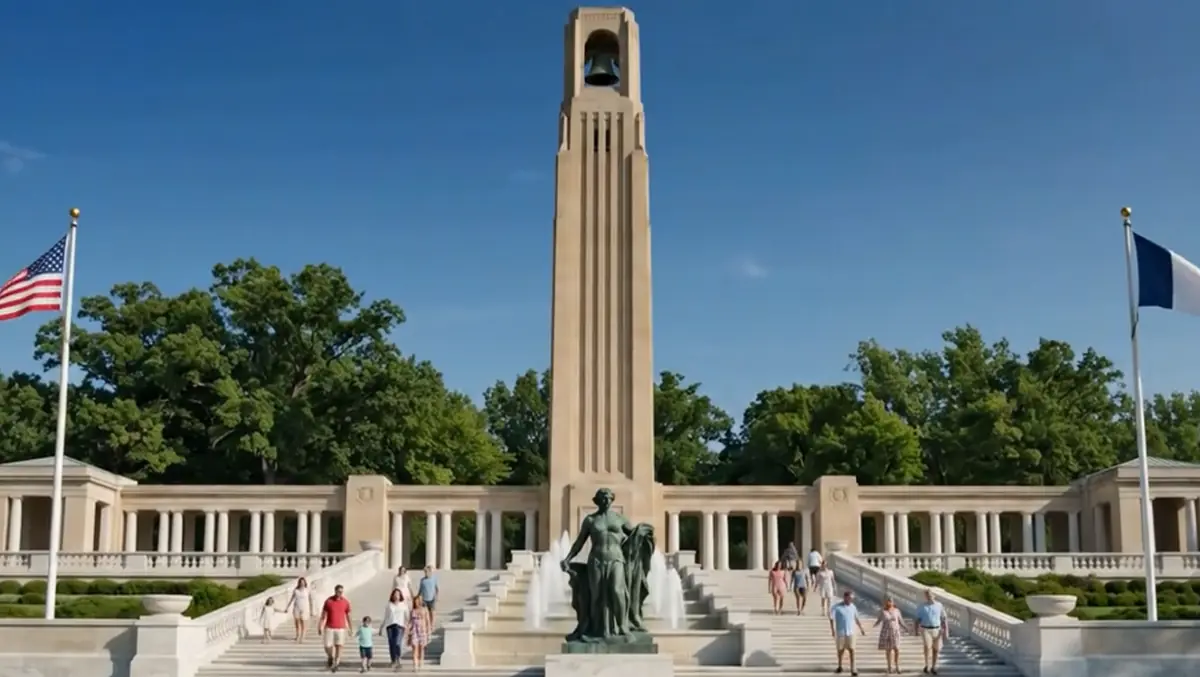
If you stand today on the western bend of the St. Joseph River, where the rush of modern traffic hums along Portage Avenue, you are standing on the shoreline of a forgotten dream that nearly changed the skyline of South Bend. Beneath the tires of thousands of daily commuters, who pass by without a glance or a thought, lies the quiet monument of an American dream so vast, so staggeringly ambitious, that it could only have been born in the roaring twilight of the 1920s.
It was an era when Americans still built on a titanic scale simply because they possessed the hubris and the pride to do so. The final roar of the 1920s monument-building before the sky fell.
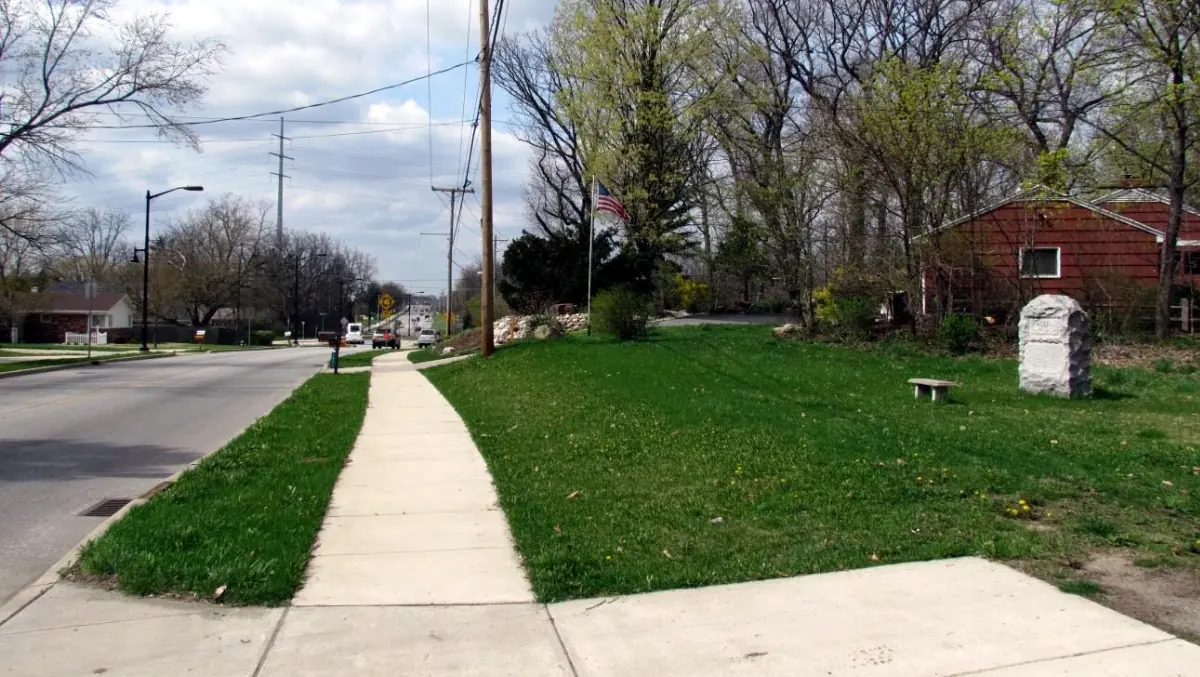
When you're headed north on Portage Avenue as you pass Riverview Cemetery, turn your eyes toward the east side of the street near, formerly beneath the ancient, sprawling boughs of the Council Oak. There, standing among a poorly kept clump of grass, rests a lonely, weathered block of stone. It is a cornerstone. To the casual passerby, it is an awkwardly placed stone piece with a simple inscription. In truth, it is the sole remaining relic of an immense monument:
The International Shrine to LaSalle.
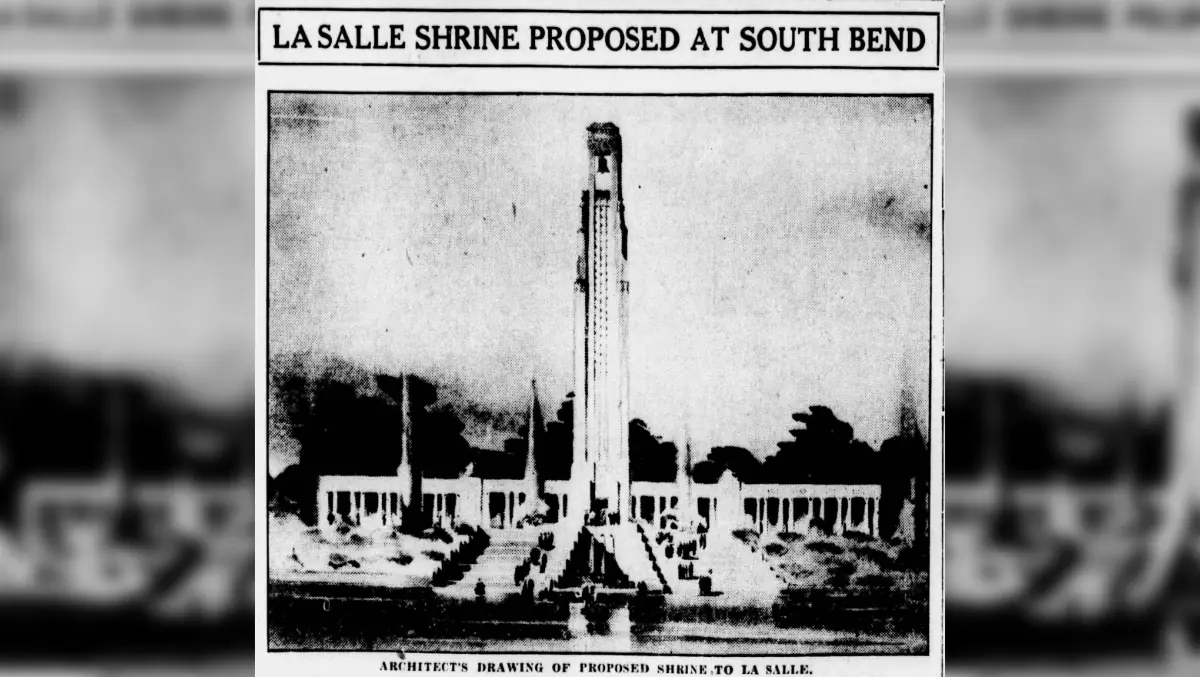
Nearly a century ago, in May of 1931, the air in South Bend crackled with a grand civic fever. Local leaders, backed by the political might of Congressman Samuel B. Pettengill and the historical zeal of Ross F. Lockridge, unveiled a blueprint by Notre Dame School of Architecture dean, Francis W. Kervick was nothing short of breathtaking. They proposed to alter the very landscape of the St. Joseph River and South Bend.
In the early 1930s, the dream of the LaSalle Shrine marched directly into the halls of the United States Capitol. It found a fierce champion in South Bend's own Congressman, the highly influential and powerful Samuel B. Pettengill. Pettengill did not merely lobby for the project; he took the fight to Washington, personally apprising every single United States senator and representative across the country of the LaSalle Memorial.
In a time when the nation was seeking symbols of unity and historic grit to withstand the economic winter of the Great Depression, Pettengill and Indiana Lieutenant-Governor M. Clifford Townsend envisioned a monument of national gravity. A Midwest equivalent to the Bunker Hill Monument. Bills were drafted, and legislation was introduced to secure federal appropriations, capturing the imagination of lawmakers from coast to coast who saw the monument as a shining, international tribute to the very opening of the North American interior.
But it also had international significance.
A subscription to the News-Times is always free.
Enter your email address and get new issues straight to your inbox.
For the French Republic, the proposed International Memorial was far less an exercise in nostalgia for its Ancien Régime than a vital piece of the chessboard of pre-war diplomacy. As the 1930s progressed and the ominous shadow of a vengeful Germany stretched across Europe, the French government viewed the LaSalle Memorial as a high-stakes pipeline for geopolitical capital with its much younger and powerful ally, the United States.
By dispatching their highly skilled ambassador to America, André de Laboulaye, directly from the French embassies of Washington to the banks of the St. Joseph River, Paris sought to actively weaponize shared history. The French state treated the South Bend commission as an official diplomatic extension, financing glittering dinners and high-profile delegations of naval officers and politicians to stoke American public sentiment. In an era where the United States was deeply entrenched in isolationism, France desperately needed to reinforce its historic alliance with Washington.
The people of France had long feared their German neighbors, dating back to Roman times, the Rhine River acted as a defense from German aggression. Every stone of the proposed monument, deliberately styled after the classical grandeur of Versailles, was meant to serve as a permanent, psychological anchor, reminding a reluctant American public of the blood and ideals that had bound the two nations together since the days of Lafayette and the shared fight waged 10 years prior in World War I. France realized German democracy was collapsing into a hyper-aggressive, vengeful regime and war was a very real possibility. Hence the need for this stone monument of friendship. The monument to the daring knight of France's Golden Age, exploring under the direct banner of the “Sun King” himself, King Louis XIV (who personally signed the letters to sign off on LaSalle's expedition on May 12, 1678) was the queen on France's geopolitical chessboard.
Yet, this complex geopolitical gambit by the government of France required an equally sophisticated American partner to anchor it and France found its champion just across the cornfields at the University of Notre Dame. By the 1930s, Notre Dame was rapidly outgrowing its image as a provincial Midwestern college, beginning to flex its muscles as an institution of booming national and international prestige thanks in large part to its famed football program and the surge in Catholic immigrant communities.
Led by forward-looking administrations like those of Father Charles L. O'Donnell, C.S.C., and Father John Francis O'Hara, C.S.C., the university recognized the opportunities to capitalize on the French cultural capital. Americans held France in high regard and retained a very romantic, pro-French sentiment from its aid in our Revolution. Our Lady of the Lake was founded in 1842 by French priests of the French Congregation of Holy Cross, Father Sorin himself being from Mayenne province in France and the Congregation of Holy Cross established in Le Mans, France. Notre Dame possessed deep historical roots tying it back to the mother country, roots its leadership was now ready to leverage on a global stage.
When Ambassador de Laboulaye and his entourage arrived in South Bend, they didn't meet isolated, provincial academics beneath the famously strong egos of the French; they met highly educated, European-traveled Holy Cross priests who spoke fluent French, understood old-world diplomatic protocols, and could host international dignitaries as cultural peers. Father Charles O'Donnell brought the practical grit of a former World War I military chaplain who had served in the trenches of France, while Father John O'Hara brought the sharp instincts of a diplomat's son. Together, they threw Notre Dame's escalating institutional weight into the LaSalle project.
It was a star of their own faculty, architect Francis W. Kervick, who drew the blueprints for the soaring carillon tower. To ensure Notre Dame held a firm hand on the project's steering wheel, Father O'Hara's administration permitted Father John Ryan, C.S.C., a European-educated scholar from the university's history department, to step into the political arena as the Secretary-Treasurer of the official State Commission appointed by Indiana governor Harry Leslie.
By deploying its intellectual resources, its sophisticated French heritage, (and the booming fanfare of its famous marching band), Notre Dame successfully elevated a local commemoration into a high-level international theater. In doing so, the university proved it was no longer just a regional school famous for gridiron success, but a rising powerhouse capable of commanding the attention of the United States Congress, the French Embassy, and taking another big step onto the national and world stage.
The university threw its full weight behind the endeavor. Francis W. Kervick, the brilliant Notre Dame architect who drafted the monument's soaring limestone and marble design, was a revered member of the university faculty.
On that rainy spring afternoon on May 19, 1931 when the cornerstone which you drive past daily now on Portage Avenue was finally dedicated, the air was filled with the brassy, defiant sound of a massed band, spearheaded by the University of Notre Dame's famous marching band under the direction of Professor Joseph Casasanta playing the “Star Spangled Banner” and “La Marseillaise” to the crowd of thousands. The project looked to be a forgone conclusion.

History rarely conforms to the neat architecture of Francis Kevrick's blueprints. The grand design and vision that appeared to be a done deal on that rainy afternoon in May of 1931, was already fracturing. As the people left the events of that day. Visible economic rot was eating away at the foundations of the world economies. The Great Depression, which had begun its slow, suffocating stranglehold on the American economy, was no longer a temporary market correction, it was collapsing. The financial realities began to erode the project's grand capital funding, as politicians ran for cover.
For a few years, the LaSalle Memorial Commission tried to fight off the onslaught. They fought to keep the magnificent dream alive against the rising tide of bad news, pushing the projected completion date from 1931 to 1936, then 1937 (as marked in the attached image from the souvenir of that day), and finally, hopelessly, to 1939. Congressman Samuel B. Pettengill worked the floors of Congress, inserting the plans into the Congressional Record, hoping a federal lifeline might materialize, potentially as a WPA project. Local donors were ruined, and across the Atlantic, the French government that lent the project its global prestige had to shift from investments in goodwill projects to building tanks, planes and ships.
Yet, the final, fatal blow to the LaSalle Memorial was delivered not by the stock market, but by the very visible, highly vengeful hand of the President of the United States, Franklin D. Roosevelt.
To secure the millions of dollars needed to erect a 125-foot carillon of limestone and white marble during the Depression, South Bend desperately needed federal public works funding, the vital, flowing rivers of cash controlled by Franklin D. Roosevelt's New Deal. But South Bend's champion in Washington, Congressman Samuel B. Pettengill had committed the ultimate, unforgivable sin in the eyes of congressmen desperate for attention (and dollars from Roosevelt's New Deal administration): he had crossed the President.
Pettengill, though a Democrat, was a fierce constitutionalist who grew deeply alarmed by what he viewed as Roosevelt's executive overreach. When FDR unveiled his infamous 1937 "court-packing" scheme to subvert a hostile Supreme Court, Pettengill did not merely balk, he became one of the rebellion's loudest, most articulate leaders that crushed the attempt.
Behind Roosevelt's famous, uptilted cigarette holder and warm, beaming radio smile lay a ruthless political operator of cold, calculating vindictiveness. FDR did not tolerate dissent from within his own party. In the savage political purge of 1938, the White House actively sought to destroy the careers of conservative Democrats who had defied the executive will. Pettengill was marked for political execution.
A subscription to the News-Times is always free.
Enter your email address and get new issues straight to your inbox.
The LaSalle Memorial became collateral damage in Washington's bloodiest intra-party feud. While federal WPA and PWA funds flowed like water to projects championed by loyal Roosevelt sycophants across the nation, South Bend's grand international shrine was quietly, deliberately shelved. The federal matching grants that would have built the shrine were strangled by a spiteful administration.
Though highly popular in his district and in the state of Indiana, Congressman Pettengill, weary of the relentless political warfare and facing the crushing weight of the presidential machine, chose not to run for re-election in 1938. When he walked out of the Capitol in January of 1939, the LaSalle Memorial's last hope for federal support walked out with him. The project was to be a multi-state triumph. A scenic Riverside Highway that would've snaked northward all the way to St. Joseph, Michigan, terminating at a meticulously reconstructed Fort Miami. It was an audacious tribute to a time when international and imperial destinies were made with the stroke of a sword and the smoke of a peace pipe.
By fall of 1938 Hitler had retaken the Rhineland, Sudetenland and annexed Austria without firing a shot, the window of opportunity was slamming shut. The international partners were desperately pivoting their national budgets away from cultural monuments and toward military mobilization to counter the rising threat of Germany. By the time German Panzers roared across the Polish Frontier in September of 1939, the International Shrine to LaSalle was completely dead. Money that would be used mining limestone from southern Indiana quarries was allocated for battleships and bombers. By June of 1940 France had fallen only 6 weeks after being invaded; and the diplomatic ties that bound South Bend to France were severed overnight.
When the global slaughter finally ended in late 1945, the cultural landscape had fundamentally shifted. An exhausted, forward-looking nation had no desire to look back at 17th-century French explorers or the romanticism of the imperial Sun King. A new generation of Americans wanted suburbs, neon, television, interstate highways, and a clean slate. The era of building monuments on a grand scale was seen as a relic and mentality of the Old World that brought suffering across the New World. The blueprint for the limestone and white marble shrine was quietly rolled up (maybe still sitting in the Hesburgh Library archives on Notre Dame's campus) the dreams of a Versailles inspired monument on the St. Joseph River was filed away in the dark recesses of municipal memory, and the grand vision became a dead ghost story. This grand plan lay forgotten. Except for a lone, nostalgic retrospective by a mysterious person only named “P.L., South Bend”, on page 3 of the South Bend Tribune in 1972 where they surprisingly shared the blueprint of the memorial, the International Shrine vanished into total obscurity.
Today, the French diplomats are long gone. The congressional resolutions are buried in dusty, yellowed legislative archives. And there, at the edge of what is now Pinhook Lagoon (itself a New Deal project, used as a political tool to sway the support of Congressman Pettengill to Roosevelt) on the banks of the St. Joseph River, the exact location where Kervick's magnificent, 125-foot white carillon tower was meant to pierce the sky along the flowing river. The single, lonely block of Indiana limestone sits on Portage Avenue.
Where wide, theatrical stone steps of marble and limestone were meant to cascade down to the water, which had welcomed LaSalle, and would welcome global travelers, there is only undergrowth and dumped trash. Approved by Washington, blessed by Notre Dame, and celebrated by Paris, that original cornerstone is now the only memory of the project, passed by without notice by thousands of daily commuters driving down Portage Avenue. It stands quietly as a monument of a lost age.
This plan lay forgotten as a casualty of political vengeance, economic ruin, and global war. The memory of this forgotten colossus did not resurface through an academic agenda or a state-funded excavation of old archives. It happened because of a simple eBay search. I stumbled upon its original 1931 souvenir program on eBay (I was looking for a LaSalle High School souvenir for my proud alumni parents) when I stumbled upon this faded green program, this article was written about the treasure I acquired for only four dollars. History is funny like that, the digital age in which we live and can educate and inspire readers of stories like this one to revisit these ideas and allow us to dare to dream once more. But perhaps, now that the dust has been brushed off the pages, the story isn't quite over. Perhaps there is a future that can still happen for the International Memorial to LaSalle? The cornerstone still stubbornly waits along Portage Avenue. Perhaps, after nearly a century of silence, the trail can finally warm up again. Perhaps there is a future yet unwritten for the International Memorial to LaSalle?
More to come soon.